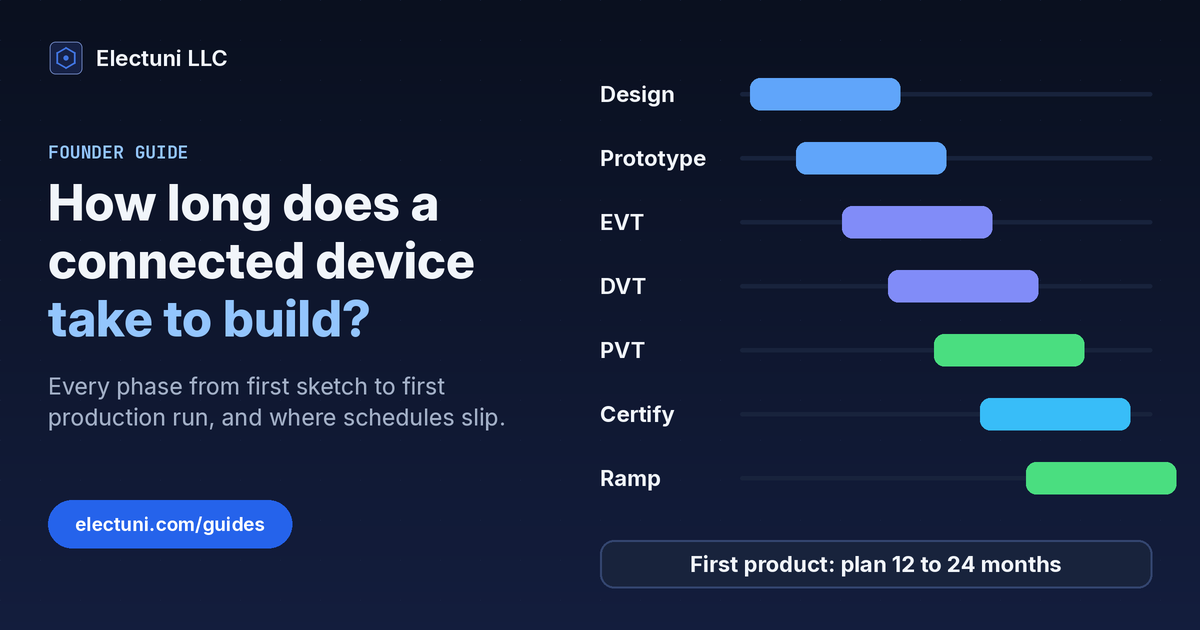
How long does a connected device take?
Founders usually ask this on the first call, and the honest answer is a range. Memfault, a firmware tools company, describes a 6-milestone schedule that takes a product from prototype to launch in roughly 12 to 18 months. John Teel at Predictable Designs puts it a little longer: most hardware products need 1.5 to 2 years to get to market. Blues, which builds connectivity hardware, lays out a 48-week roadmap for a connected product and says it's modeled on the upper bound of each stage.
Those numbers don't disagree as much as they look. They just start the clock at different points. Some start at a working prototype, some at the first sketch, and some assume the design team has done this before. For a first product with a radio, a custom board, an enclosure and an app or dashboard, 12 to 24 months from idea to the first production run is a fair planning range.
What sets your number inside that range isn't how fast anyone types. It's how many times the board and the enclosure have to be rebuilt, when certification testing starts and how many requirements change after design begins. This guide walks through each phase, shows where connected devices lose time and gives you a checklist for a launch date you can defend.
The phases, with typical durations
Here's the path from an approved idea to units in boxes. You'll see it's longer than most first plans. The durations come from the published sources in the box at the end of this guide. Treat them as planning ranges. They aren't promises.
| Phase | What happens | Typical duration |
|---|---|---|
| Discovery and architecture | Requirements, feasibility, block diagram, key component choices, risk list | Weeks 3 to 11 in the Blues roadmap, shared with early design |
| Schematic and PCB layout | Circuit design, then the physical board | 2 to 5 weeks each |
| Design review | An independent check before money goes into boards | 1 to 3 weeks |
| First prototype boards | Fabrication and assembly | 1 to 2 weeks to receive |
| Bring-up and debug | Power up, test every block, find the bugs | 5 weeks, often more |
| Proto milestone | Prove the idea works on real hardware | About 12 weeks |
| EVT | Engineering validation: the design meets its specs | About 8 weeks |
| DVT | Design validation: final enclosure, reliability, certification samples | 6 to 8 weeks |
| PVT | Production validation: the factory builds it at rate | 6 to 8 weeks |
| Ramp | Volume grows to the target build rate | 4 weeks or more |
The board numbers come from Predictable Designs. The milestone numbers come from Memfault's NPI schedule. If EVT, DVT and PVT are new terms, our guide EVT, DVT and PVT explained covers what each build proves and how many units to plan.
Firmware doesn't appear as one row because it runs the whole way through. Predictable Designs gives firmware 1 to 6 months on its own, and for a connected device that's the device code only. The cloud backend, the dashboard and the phone app sit on top of it.
A connected device runs on four tracks at once
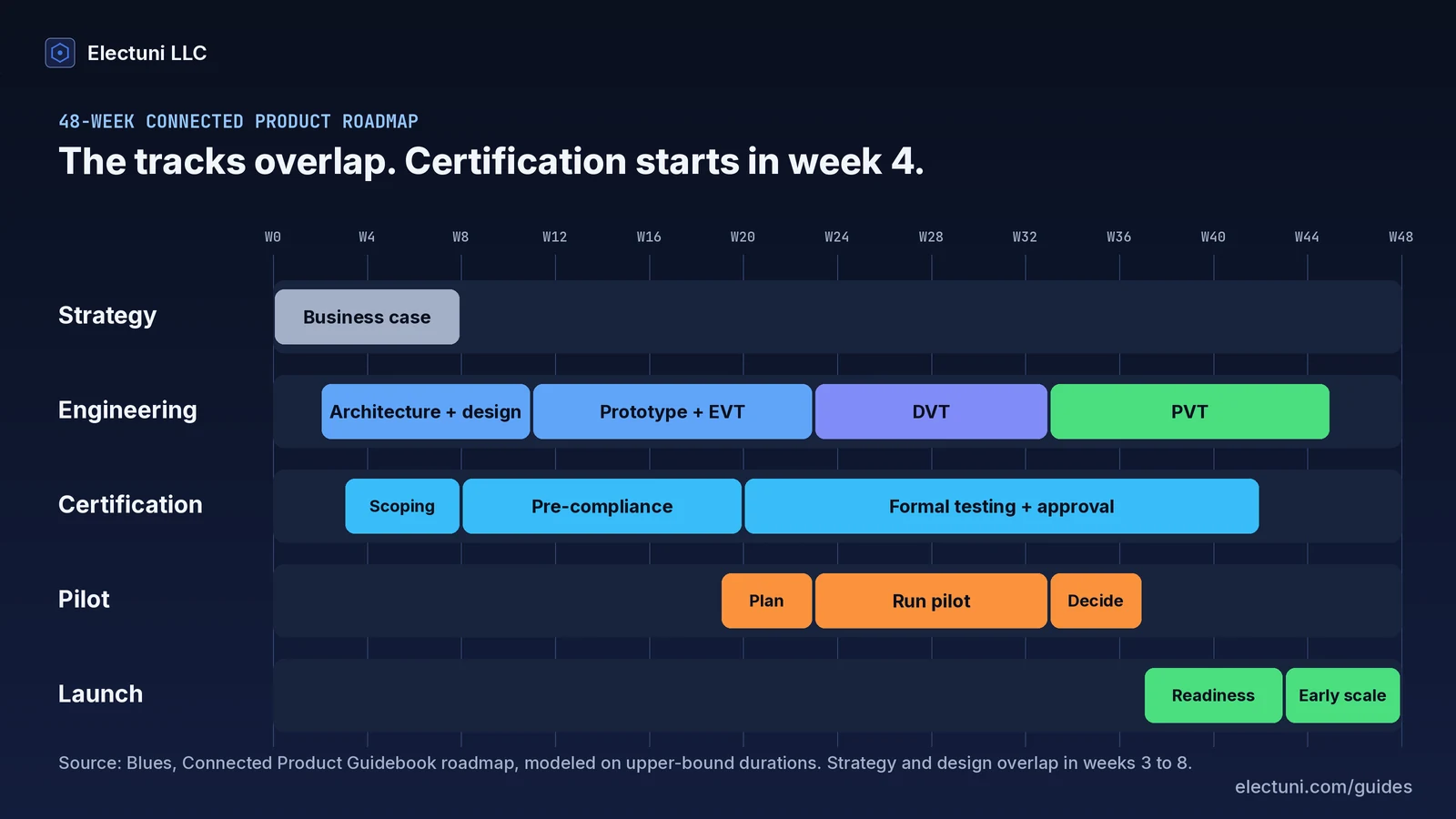
A timeline for a simple gadget is mostly a line. Yours isn't. A connected device is closer to a set of lanes. The board, the firmware, the enclosure, the cloud side and the certification work all move at the same time, and they hand things to each other at fixed points.
Hardware
The board is rarely right on the first spin. Each spin means a new layout, new boards, assembly and another round of testing. Predictable Designs notes it takes another couple of weeks just to order a revised board, before any testing starts.
Firmware
Firmware has its own gates. They're tied to the builds. Memfault's schedule says the manufacturing firmware, the code the factory uses to program and test units, has to be locked between EVT and DVT. The update path has to work before the first unit ships too. If customers get firmware that can't update, every bug found later costs a recall instead of a download. Our guide on what to own when your firmware contractor leaves lists the pieces you need for that.
Enclosure
Mechanical work often takes longer than you'd expect. Predictable Designs suggests at least a month for the 3D model, up to 6 months if it's complex, at least 4 weeks to test and revise printed prototypes and 1 to 3 months to prepare the design for injection molding. For a radio product the enclosure isn't just a shell. Blues advises testing in your actual enclosure early because enclosure materials directly affect RF performance.
Cloud, dashboard and app
Your device has to talk to something. Provisioning, the backend, the dashboard and the app can usually be built against a development board long before your custom hardware exists, which is one of the easiest ways to take weeks out of the plan.
Where connected device schedules slip
Late launches are normal across all kinds of products. Memfault cites a Gartner survey which found that nearly half of products miss their launch date. In hardware the slips cluster in a few predictable places.
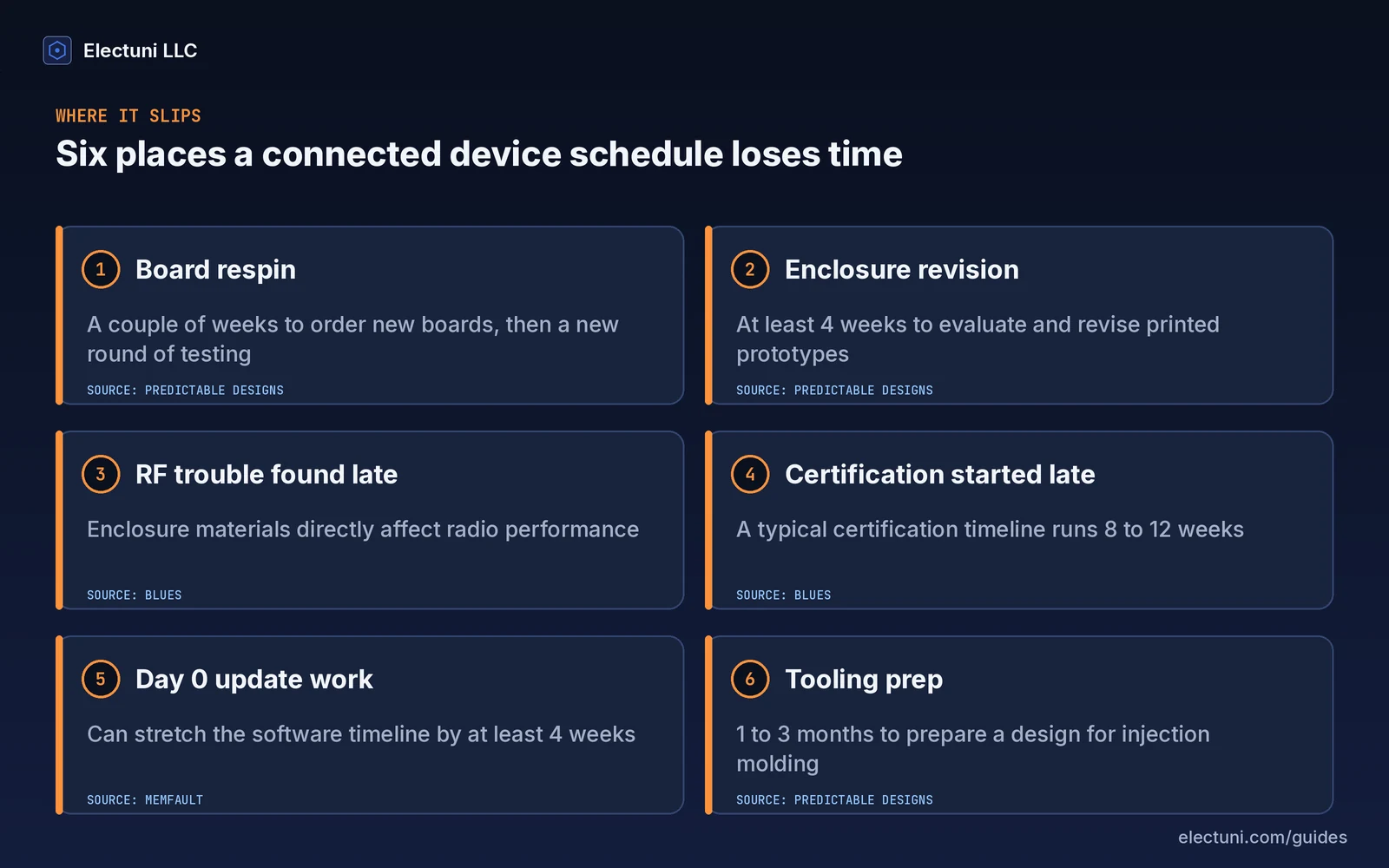
- Board respins. Every spin repeats ordering, assembly and test. A spin that wasn't in the plan pushes every later phase back with it.
- Enclosure rounds. A button that doesn't press, a seal that leaks or a board that doesn't fit means another round of prints, then another round of fit checks.
- Radio trouble found late. An antenna that worked on the bench can lose range once it's inside plastic, near a battery or next to a metal bracket. Found in DVT, that's a layout change and maybe a tooling change.
- Certification started late. Blues puts a typical certification timeline at 8 to 12 weeks. If pre-compliance testing never happened, a failed emissions test sends you back to the board.
- Day 0 update work. Features added after EVT keep the firmware moving when it should be settling. Memfault notes that pushing work into a "day 0" update can stretch the software timeline by at least 4 weeks.
- Tooling prep. Predictable Designs allows 1 to 3 months to prepare a design for injection molding. Start it before the enclosure is final and you'll pay for the changes twice.
One more slip sits above all six: requirement changes. A new sensor, a bigger battery or a different radio after design starts can undo weeks of layout and mechanical work in one decision.
None of these are rare. We've seen every one of them. A good plan doesn't pretend they won't happen. It puts a buffer in front of each one and moves the risky tests as early as you can manage.
Certification sets the earliest real ship date
For a connected device, certification isn't paperwork you'll get to at the end. In the US it decides the first day you can ship. Under 47 CFR 2.803, a device that needs FCC certification can't be delivered to end users before the authorization process is complete.
The same rule does allow some selling before the grant. Conditional sales and pre-orders are permitted if buyers get a prominent notice that delivery depends on the device passing the FCC process. Units can go to other companies for pre-sale work, such as packaging, only after testing at an accredited lab is done and the application has been submitted. So your crowdfunding campaign can take orders. It can't ship them until the grant is issued.
Radio standards add their own steps. If your product uses Bluetooth, it also goes through Bluetooth SIG qualification. The SIG's own guide splits that into 5 phases: product details, design specification, an administrative fee, submission and verification. The online part can be quick, but testing may be required depending on your design, and the SIG says invoice processing alone can take 1 to 2 weeks.
The way to protect your date is simple. Start early. In the Blues roadmap, certification scoping starts in week 4 and pre-compliance testing runs from week 9, long before formal testing. A pre-certified radio module can also cut down the work, because much of the radio testing has already been done for the module.
How to shorten the timeline without cutting corners
You can't skip validation builds or certification. What you can do is stop losing time between them. Here's what we'd do first.
- Freeze requirements before layout. Write down what the product must do, where it will be used and what it must pass. Change control after that point should be a decision, not a chat message.
- Run the tracks in parallel. Start firmware on a development board, the cloud side against a simulated device and the enclosure from the board outline, all while the first boards are being built.
- Review before you fab. An independent design review costs 1 to 3 weeks. A respin caused by a missed error costs the order time, the assembly time and another round of test.
- Plan for one respin. Put it in the schedule. If you don't need it, you're early. Nobody's ever complained about that.
- Test the radio in the real enclosure early. Use printed shells in the final material as soon as you can get them.
- Book pre-compliance testing during EVT. Finding an emissions problem on an EVT board is a layout fix. Finding it after tooling is a much bigger job.
- Lock the factory firmware on time. The factory needs stable programming and test code before DVT.
Running the tracks in parallel with one team is the main reason we can offer 40% Faster MVPs. A minimum viable product still needs real hardware and real tests. It just doesn't have to wait for each discipline to finish before the next one starts.
Timeline planning checklist
Use this when you build or review your schedule. It's short on purpose. Each row is a question to answer before you commit to a launch date.
| Phase | Ask before you commit | Ready when |
|---|---|---|
| Discovery | Are the requirements written and agreed? | One document, signed off, with the markets you'll sell in |
| Architecture | Which parts have long lead times or only one source? | A risk list with a backup plan for each item |
| Design | Has someone outside the design team reviewed the board? | Review notes closed before ordering boards |
| Prototype | Is one respin in the plan? | Weeks for a second spin are in the schedule |
| EVT | When is pre-compliance testing booked? | A lab date during EVT, not after DVT |
| DVT | Is the manufacturing firmware locked? | Factory programming and test code frozen |
| Certification | Which marks do you need and who files them? | Lab chosen, test plan agreed, label design ready |
| PVT and ramp | Can the factory build at rate with your test fixture? | Pilot units pass at the target build rate |
How Electuni plans a connected device timeline
Our projects follow 6 steps: Discovery, Architecture, Design, Review, Prototype and Handoff. The timeline gets built in the first 2. Discovery turns your idea into written requirements and the open questions. Architecture adds the block diagram, the key component choices and a risk list. That's where we'll flag long lead time parts, the radio and enclosure risks and the certification path before any layout starts.
One team covers the board, the firmware, the enclosure CAD and the cloud and app side. That's what lets the tracks run in parallel instead of in a queue. Electuni LLC is a US company founded in 2016, with 500+ PCB designs delivered and 500+ production boards shipped. Our lead engineer is IPC CID+ certified.
See IoT systems, hardware design, firmware development and 3D enclosure design, or read what you receive at each step on How we work.